ScaffMS did not start as a startup idea. It started as frustration.
While working in the construction industry, I led the technology side of a project worth approximately €160 million. I was close enough to the site to see the day-to-day reality, and close enough to management to understand the real cost of inefficiency.
One issue kept surfacing, no matter how well everything else was planned.
Asset management.
Assets Never Stop Moving. Visibility Does.
Construction assets are constantly on the move.
Between sites, phases, subcontractors, and storage yards.
Visibility, however, breaks far more easily.
Scaffolding became one of the clearest breaking points. High-value, modular, safety-critical, reused everywhere, yet managed in some of the most fragile ways imaginable.
The same visibility issues appeared across other types of equipment as well.
Spreadsheets. Phone calls. Emails. WhatsApp messages.
And the classic:
“Ask George, he knows.”
Basic operational questions were surprisingly difficult to answer:
- Where are our assets right now?
- Who is using what?
- In what condition?
- When will they actually be available again?
Future availability was almost impossible to predict. Planning relied on assumptions and gut feeling rather than data.
The result was predictable.
Delays. Emergency rentals. Duplicate orders. Wasted time. Constant firefighting.
I Looked for Software. I Found the Wrong Kind.
Naturally, I assumed software already existed to solve this problem.
So I researched the market extensively.
What I found was remarkably consistent:
- High licensing and implementation costs
- Systems designed for generic industries, not construction
- Long setup cycles and heavy customization
- An implicit assumption that customers have in-house software engineers
Here is the reality few people say out loud.
Most construction companies do not have software engineers. And even when they do, they certainly do not have teams available to support complex systems that require constant technical attention.
If a system needs months to configure and specialists to operate, it will not survive on a construction site.
Complexity Is the Wrong Direction
Construction does not need more complex software.
It needs usable software.
If a foreman, site engineer, or asset manager cannot understand and use a system quickly, it will fail. It does not matter how powerful or feature-rich it looks in a demo.
In construction, simplicity is not a compromise.
It is a requirement.
That means:
- Workflows that reflect how sites actually operate
- Clear visibility without technical friction
- Minimal training
- Fast answers instead of feature overload
Why I Built ScaffMS
ScaffMS was built as a direct response to all of this.
Not to impress with complexity. Not to add another dashboard. But to remove friction.
It is a construction-first asset management system, designed around how assets really move between sites, projects, yards, and people.
A tool that provides clarity without demanding technical expertise.
Built from real project pain, real operational failures, and one simple belief:
If software does not make life easier on-site, it has no place in construction.
Let’s Talk
I am genuinely curious to hear from others in the industry.
Have you seen construction software actually work well on-site?
If this resonates, I would be interested to hear your experience. Many of us have been trying to solve the same problems in isolation for far too long.
A Final Note on Reality
I am not sugarcoating what asset management looks like in construction.
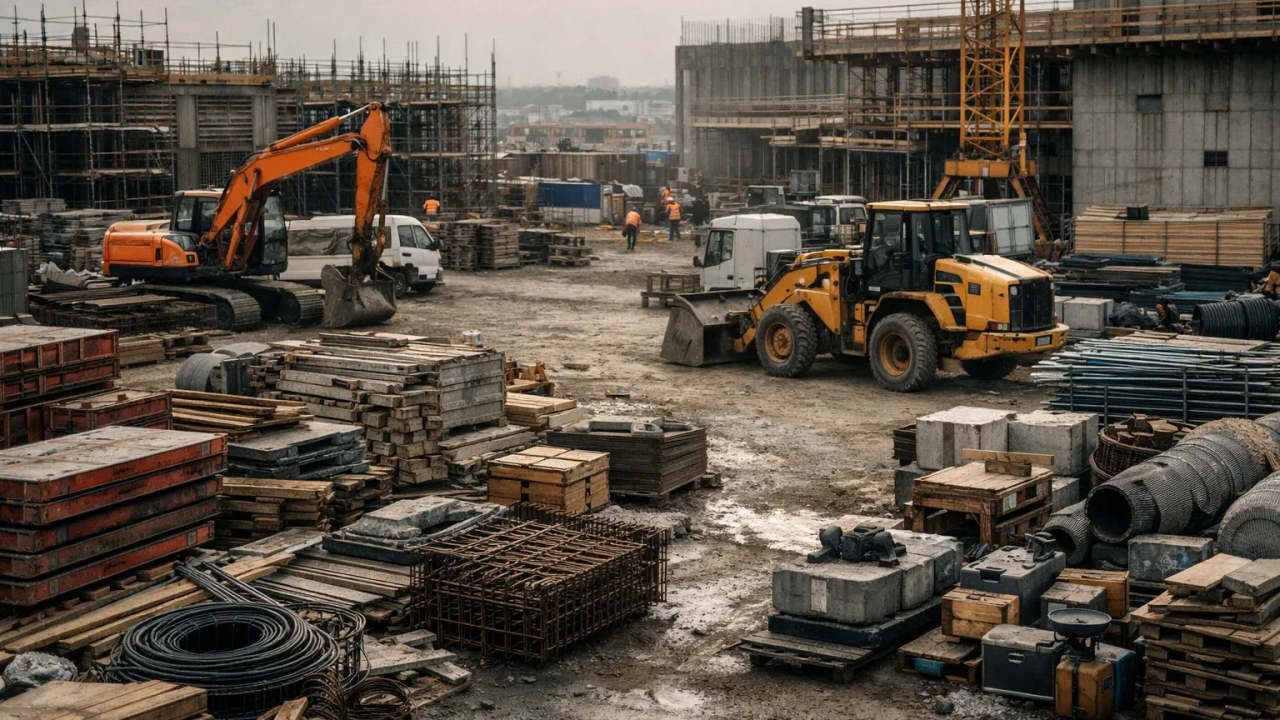
The image in this article is intentional. This is the reality of most yards and construction sites. Assets spread across space, phases, crews, and priorities. Valuable material waiting, moving, being reused, or temporarily forgotten.
This is not a failure of people.
It is the natural state of construction operations.
That reality is exactly why absolute control and visibility matter. Not control for control’s sake, but clarity.
Knowing what you own, where it is, and what is actually available — even when the environment is messy and dynamic.
ScaffMS exists because construction will never look clean and predictable.
The systems supporting it should bring order without pretending otherwise.
Christos Kyriacou Founder, ScaffMS